
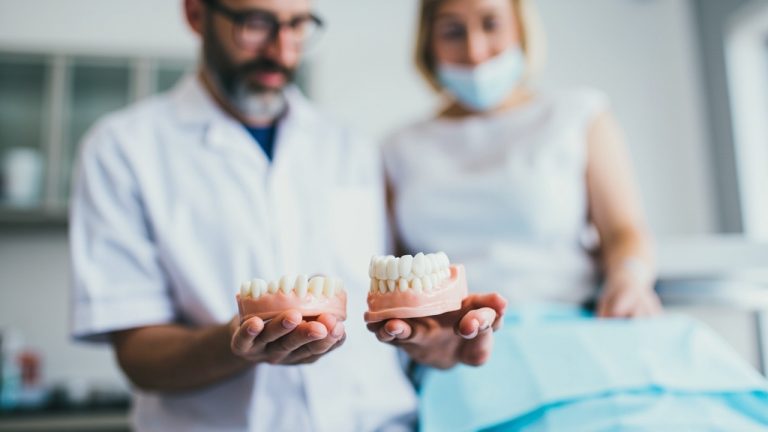
Losing a tooth changes more than your appearance. It can affect how you chew, how you speak, and even how confident you feel ordering your favourite meal. The good news is that modern restorative dentistry offers reliable tooth replacement options. Two of the most common are a dental bridge and dentures.
If you have been told you need to replace missing teeth, you may be wondering which solution fits your lifestyle, your oral health, and your long term goals. The answer is rarely one size fits all. Understanding how a fixed prosthesis compares with a removable prosthesis makes the decision far less overwhelming.
What Is The Difference Between A Dental Bridge And Dentures?
A dental bridge is a fixed prosthesis used to replace one or a few missing teeth. It is supported by adjacent teeth that are carefully prepared to anchor the bridge in place. Once cemented, it remains in position and functions similarly to natural teeth.
Dentures, on the other hand, are a removable appliance. They can replace multiple missing teeth or even a full arch. Partial dentures sit around remaining natural teeth, while complete dentures rest on the gums where all teeth are missing.
Both options fall under restorative dentistry and are designed to restore chewing function and speech adaptation, but they differ significantly in structure, stability, and maintenance requirements.
How Does A Dental Bridge Work?
- A fixed dental bridge involves several carefully planned steps:
- Preparation of supporting teeth
- Impression or digital scan
- Laboratory fabrication
- Cementation appointment
Because the bridge is secured to adjacent teeth, it offers stability during eating and speaking. It is often recommended when one or a few missing teeth are present and the surrounding teeth are strong enough to provide support.
However, preparation of adjacent teeth is required. This is an important consideration, as healthy enamel may need to be reshaped to accommodate the bridge.
How Do Dentures Replace Missing Teeth?
- Dentures involve a different process:
- Impressions of the gums
- Bite registration
- Try in stage
- Delivery and adjustments
A removable appliance rests on the gums and relies on bone support and soft tissue adaptation. Some people adjust quickly, while others require a longer adjustment period to feel confident.
Dentures do not alter adjacent teeth, which can be beneficial in certain situations. However, they do require removal for cleaning and may move slightly during chewing depending on fit and bone preservation considerations.
How Do Stability And Daily Comfort Compare?
Stability is one of the most discussed attributes when comparing these two tooth replacement options.
| Feature | Dental Bridge | Dentures |
|---|---|---|
| Type | Fixed prosthesis | Removable appliance |
| Stability | Secured to adjacent teeth | Rests on gums |
| Suitable For | One or a few missing teeth | Multiple or full arch replacement |
| Cleaning | Brushing plus floss threaders | Removed for cleaning |
| Adjustment Period | Usually minimal | May require adaptation |
| Impact on Adjacent Teeth | May require preparation | Does not alter adjacent teeth |
| Bone Support | Does not prevent bone loss | Does not prevent bone loss |
A bridge generally feels more secure because it is fixed. Dentures may require muscle adaptation, particularly during the early stages of speech adaptation and chewing.
What About Oral Hygiene And Maintenance Requirements?
Cleaning a fixed prosthesis requires brushing and specialised floss threaders to clean beneath the bridge. Consistent oral hygiene requirements are essential to protect supporting teeth from decay or gum disease.
Dentures must be removed daily for cleaning. This includes brushing the denture surface and maintaining gum health. Plaque accumulation on either solution can lead to complications if not addressed.
Longevity considerations also differ. Bridges may last many years when properly maintained, while dentures may require periodic adjustment or replacement as bone support changes over time.
Does Either Option Prevent Bone Loss?
Neither traditional bridges nor conventional dentures prevent bone preservation loss in the jaw where the tooth root is missing. Over time, bone can gradually resorb in areas without stimulation. This can influence fit, facial structure, and overall oral health.
In some cases, a dental implant alternative may be discussed, but suitability depends on medical and oral health history considerations.
How Do You Decide Which Option Suits You?
- Treatment suitability depends on several factors:
- Number of missing teeth
- Health of adjacent teeth
- Bone support levels
- Gum condition
- Medical history
- Personal preference regarding fixed versus removable solutions
- A thorough assessment, including radiographic imaging, helps determine whether a fixed dental bridge or partial denture is appropriate.
The team focuses on balanced information. That includes discussing preparation of adjacent teeth, longevity considerations, and realistic expectations for stability and comfort. Rather than pushing one solution, the approach centres on personalised dentist treatment suitability.
What Does Current Australian Guidance Say About Tooth Replacement?
National oral health guidance emphasises the importance of replacing missing teeth to support chewing function, speech clarity, and overall oral health stability. Maintaining gum health and preventing plaque accumulation around any prosthesis is critical for long term success.
Important FAQs
Q1. Is A Dental Bridge Stronger Than Dentures?
A dental bridge is fixed in place and generally offers greater stability during chewing. Dentures can function effectively but may require adaptation depending on bone support.
Q2. Can Dentures Replace A Single Missing Tooth?
Yes, a partial denture can replace one tooth. However, a fixed dental bridge may also be suitable depending on adjacent teeth health.
Q3. Do Bridges Damage Adjacent Teeth?
Supporting teeth must be prepared to anchor a bridge. This reshaping is carefully planned to ensure long term function and protection.
Q4. How Long Do Dentures Last?
Dentures may require adjustments over time due to natural changes in bone and gum tissue. Regular reviews help maintain fit and comfort.
Q5. Is Cleaning More Difficult With A Bridge?
Bridges require specialised cleaning techniques such as floss threaders. With proper instruction, most patients manage well.
Q6. How Do I Know Which Option Is Right For Me?
A clinical assessment considering missing teeth, bone support, and oral hygiene habits will determine the most suitable tooth replacement option.
References
- Australian Dental Associationhttps://www.ada.org.au
- Australian Government Department of Health Oral Health Resourceshttps://www.health.gov.au/health-topics/oral-health
- Dental Board of Australiahttps://www.dentalboard.gov.au
Disclaimer
All dental procedures involve potential risks and benefits. The information provided in this blog is general in nature and should not be taken as medical advice. We recommend that you seek guidance from a suitably qualified health professional before making decisions about your oral health. Where appropriate, you may also wish to consider obtaining a second opinion.Any images or videos featured are shared with the informed consent of our patients and are intended for educational purposes only. They are not a guarantee of results, as every patient is unique. Treatment outcomes — including recovery, potential complications, and effectiveness — can vary from person to person.